

 English
 عربى

News
Home / News / Industry News / Material Handling Totes: A Practical Guide to Rotomolded PE Containers
Walk through almost any warehouse, water treatment plant or fish hatchery and you will find them: sturdy plastic containers doing quiet, repetitive work. Material handling totes are the reusable containers that carry parts between workstations, hold chemicals while they are dosed, keep harvested product clean, and turn an awkward pile of loose goods into a single unit a forklift can move.
They rarely attract attention, yet they shape how fast a facility runs. A tote that nests when empty saves trailer space on every return trip. A tote with the wrong wall thickness cracks at the fork pocket after a few months. A tote with sharp internal corners never quite dries after washing. Getting these details right is mostly a matter of understanding what the container has to do, then matching the material, the moulding process and the fittings to that job.
This guide walks through the whole picture: what material handling totes are, the main types in use today, how polyethylene and ABS behave in real service, where rotational moulding fits, and what to check before placing an order. The examples come from our own production floor in Cixi, Zhejiang, where we have been rotomoulding PE containers since 2007.
A material handling tote is a reusable container built to move, store or organise goods inside a facility or between facilities. It usually has a wide opening, some form of stacking or nesting geometry, and enough structural rigidity to survive repeated loading, lifting and tipping.
The category sits between several neighbours that are easy to confuse:
Almost every plastic tote shares one design assumption: it will be filled and emptied many times. That assumption drives everything else — wall thickness, corner radii, handle position, and the choice of polymer.
Why does the choice matter so much? Because the container touches four cost centres at once. Throughput depends on how quickly a tote can be filled, moved and emptied. Ergonomics depends on its weight and grip. Hygiene depends on whether residues can hide inside it. Service life depends on how the material copes with sunlight, chemicals and impact. A container that is slightly wrong in any one of these areas tends to become expensive over a few years.
Most plastic totes in industrial use fall into one of six families. They differ mainly in how they are moved and what they are expected to contain.
Rectangular, shallow to medium depth, with tapered walls so empty units nest inside each other. Used for order picking, work-in-progress and shelf storage.
Heavy-duty containers with moulded fork pockets in the base. They handle wet, granular or bulky loads that would be awkward on a pallet.
Round or square bodies with castors, or a body designed to sit on a wheeled dolly. Common where a load travels short distances without a truck.
Rotomoulded decks that convert loose goods or drums into a single stable unit for pallet trucks and racking.
Shallow containment trays that sit under drums and buckets, catching drips and small spills before they reach the floor.
Straight-sided round containers for liquids, dye baths and mixing duties where a wide mouth is essential.
For genuinely heavy loads — sand, aggregates, wet waste, bulk ingredients — the fork pocket is the feature that decides whether a container is practical. A one-piece rotomoulded body with moulded-in pockets has no seams to fail and no separate base to work loose.
Across our own catalogue, these families sit inside the PE turnover box range, which runs from 40-litre measuring buckets up to 600-litre wheeled containers.
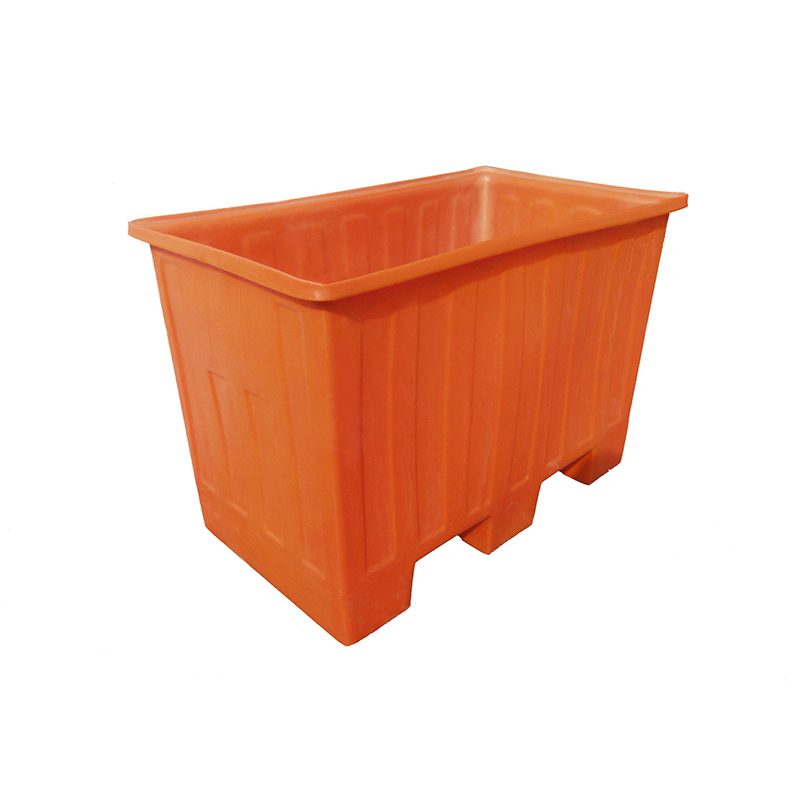 K-500L PE Forklift Bucket for Bulk Material HandlingA 500-litre polyethylene forklift bucket for light bulk handling, with a smooth interior and universal fit for most forklift models.View Product →
Plastic totes are not all made from the same polymer, and the differences show up after a few seasons of service rather than on day one. Three families dominate the containers we see in handling and processing environments.
| Material | Typical container use | Strengths | Watch-outs |
|---|---|---|---|
| LLDPE | Large totes, aquaculture barrels, floats, heavy-duty buckets | High impact resistance, excellent UV stability, good low-temperature behaviour | Softer surface; can flex under very high point loads |
| HDPE | Dosing barrels, open-top drums, small bins | Very good chemical resistance, stiffer walls | More brittle than LLDPE in cold or impact-heavy conditions |
| ABS | Small floats, fittings, cosmetic housings | Good surface finish, rigid | Lower UV and chemical resistance; not suited to heavy loads |
How the three behave on the properties that matter most in a handling environment:
For most large totes that live outdoors or get knocked around daily, LLDPE is the sensible default. HDPE is the better answer when the container spends its life holding aggressive chemistry. ABS tends to appear in small accessories rather than load-bearing containers.
Rotational moulding — often shortened to rotomoulding — is the process behind most large, seamless plastic containers. Instead of injecting molten polymer into a closed cavity, it builds the wall from the inside out. That difference explains a great deal about how these containers behave.
A precisely weighed charge of LLDPE powder goes into the mould. The weight of the charge determines the final wall thickness.
The mould is bolted shut and moved into the oven on an arm that will rotate it on two axes.
Inside the oven the mould turns slowly on both axes while the polymer melts and coats the entire inner surface. Corners, ribs and fork pockets fill evenly.
Rotation continues during cooling so the wall solidifies at a consistent thickness instead of sagging to one side.
The part is released, flash is trimmed, and the moulding is inspected for wall uniformity and surface quality.
Threaded outlets, level switches, lids, castors and reinforcement frames are fitted to turn the moulding into a working container.
The practical consequences for material handling totes are worth spelling out. Rotomoulded bodies are seamless, so there is no weld line to split when a forklift sets a full load down hard. Wall thickness can be varied across the part — thicker at the base and corners, lighter on the sides. Metal inserts can be moulded directly into the wall, which means lifting lugs and threaded connections become part of the structure rather than bolted on afterwards. And because the tooling is relatively inexpensive compared with injection moulding, a custom size becomes economically realistic at moderate volumes.
The same container that works beautifully in a freezer room can be a poor choice on a chemical dosing skid. Application drives the specification.
Priorities are stackability, a predictable footprint and low empty weight. Nesting totes with a consistent outer dimension let you reconfigure racking without re-measuring. Look for smooth internal surfaces so labels and small parts do not catch on moulding marks.
Here the container has to drain, dry and stay clean. Rounded internal corners, no hidden crevices and a wall that tolerates repeated washing matter more than the maximum load rating.
Dosing barrels and mixing tanks need a polymer that resists the specific chemistry, plus a lid, an outlet and often a level switch. Cone-bottom shapes help solids settle and drain.
Large PE barrels and floating bodies are used for breeding, hatching and grading. UV stability is non-negotiable because the containers sit outdoors year-round. You can read more about how these containers perform over long cycles in our note on the long-term role of aquaculture barrels.
Road cones, water-filled barriers and anti-collision drums are handling containers in a different disguise. They need impact resistance and colour stability above all.
Containers here take abrasive, unpredictable loads. Thick bases, moulded fork pockets and easily replaceable wheels extend service life considerably.
Where a load has to be moved short distances by hand, a wheeled body saves a surprising amount of time across a shift. A 600-litre square cart bucket is a good illustration of the idea — a single moulded body with a flat, stable base and enough volume to replace several smaller containers.
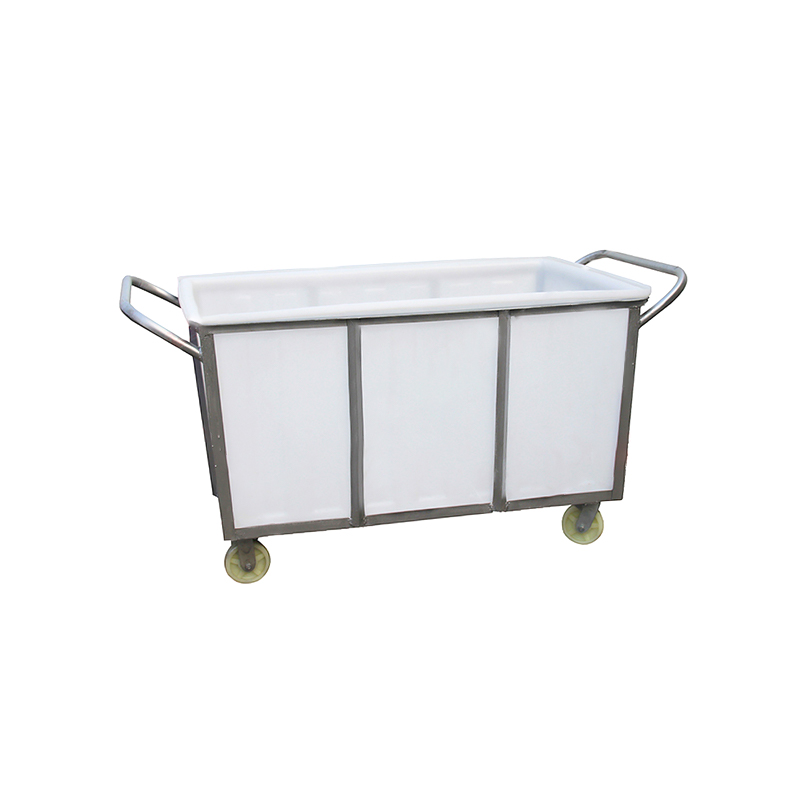 600L Square PE Cart Bucket for Industrial TurnoverA one-piece PE/LLDPE cart bucket with reinforced base, stackable square form and optional frame and wheels for workshop and logistics turnover.View Product →
Most disappointing tote purchases trace back to a specification that was never written down. Work through this list before requesting a quotation.
Compatibility is where a lot of projects quietly fail. A container can be perfectly moulded and still be useless if a pallet truck cannot reach under it or if the fork pockets are too shallow for the equipment on site. Base platforms solve part of that problem by giving awkward loads a standard, machine-friendly footprint.
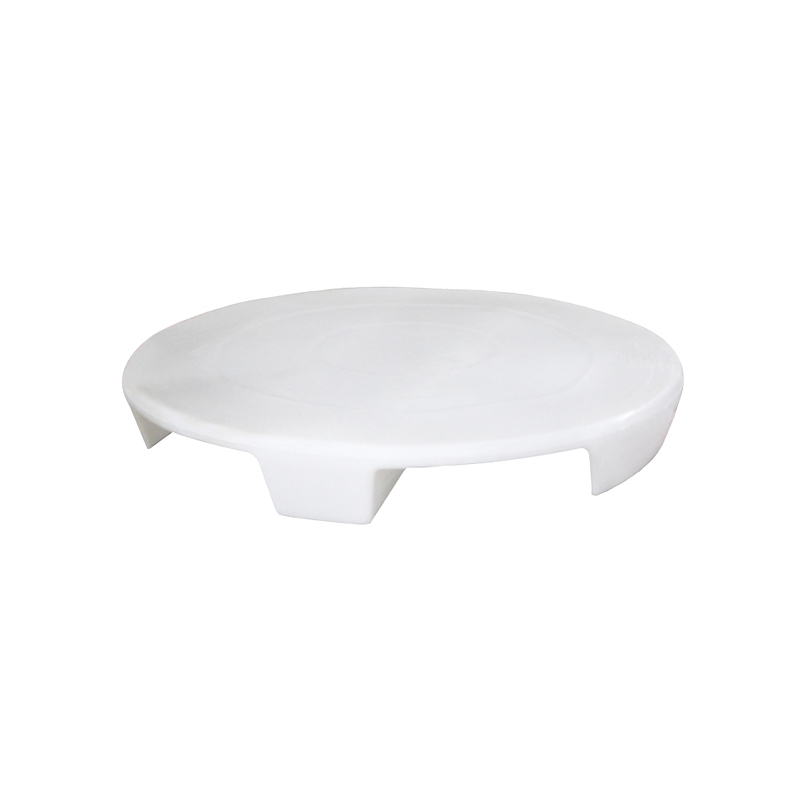 Rotational Molded Pallet Base for Machine-Friendly LoadsA rotational moulded pallet base for giving awkward loads a standard, machine-friendly footprint; contact the supplier for dimensions and load details.View Product →
Rotomoulded PE containers are low-maintenance, but a few habits make a measurable difference to how long they last.
Standard containers cover a large share of handling needs, but plenty of projects need something that does not exist in a catalogue: a specific footprint to fit an existing line, a deeper sump, an integrated divider, a mounting pattern for a pump, or a colour that matches a customer's fleet.
Rotational moulding is well suited to that kind of work. The tooling is simpler than injection moulding tooling, which makes moderate production volumes viable, and design changes such as wall thickness, corner radius or an added boss can often be handled within the same mould concept.
Because mould design and container production sit in the same facility, changes that would normally require a conversation between three suppliers can be resolved in one place. That matters most in the early iterations, when the shape of a container is still being debated.
For large containers exposed to impact, sunlight and outdoor storage, LLDPE is usually the best all-round choice. Choose HDPE when chemical resistance is the dominant requirement, and reserve ABS for small fittings and accessories.
Yes, provided the container is designed for it — a sealed, seamless body, a suitable lid and correctly specified outlets. Open-sided totes intended for dry goods should not be repurposed for liquids.
Rotomoulding produces a seamless, stress-free wall with no weld lines and no gate marks, and it is economical at lower volumes. Injection moulding offers tighter dimensional tolerance and faster cycle times at high volumes, but the tooling cost is much higher.
Yes. Footprint, depth, wall thickness, fork pockets, outlets and colour can all be adapted, and a new rotational mould can be developed for a genuinely new design.
Very little. Inspect fork pockets, handles and wheel mountings periodically, keep fittings tight, and clean with mild detergent rather than aggressive solvents.
Nesting totes save space when empty and suit operations where containers are stored between shifts. Stacking totes carry higher vertical loads and suit racking or floor stacking of full containers.
Material handling totes are easy to overlook and easy to get wrong. The containers that perform well over a decade of service are rarely the cheapest option on the quotation sheet — they are the ones whose material, wall thickness, handling interface and fittings were all chosen with the actual job in mind. Start from what the container has to hold, how it will be lifted, and where it will spend most of its life, and the specification usually writes itself.

 wuyuqiao village, Henghe Town, Cixi City, Zhejiang Province
 +86-15257871220
 [email protected]
