

 English
 عربى
عربى
News
Home / News / Industry News / How Does Wall Thickness Consistency Affect the Performance and Buoyancy of Rotationally Molded Floats?
Wall thickness consistency in rotationally molded floats directly determines buoyancy accuracy, structural load capacity, impact resistance, and long-term fatigue life. A float with ±20% wall thickness variation across its surface will displace less water than its design specification, have stress concentration points at thin sections that fail under repeated wave loading, and may fail hydrostatic certification testing even when total material weight is correct. The relationship between wall thickness and buoyancy is governed by basic Archimedes principles, but the structural consequences of thickness variation are more complex — thin zones act as crack initiation sites under cyclic loading, while overly thick zones add dead weight that reduces net buoyancy. Achieving consistent wall thickness requires understanding and controlling five variables simultaneously: powder charge weight, rotation speed ratio, oven temperature profile, mold geometry, and cooling rate.
Buoyancy is determined by the volume of water displaced by the float minus the weight of the float itself. For a hollow rotationally molded float, the external dimensions define displacement volume while the wall thickness defines the float's own weight. Every additional millimeter of average wall thickness adds dead weight that reduces net buoyancy by the density of LLDPE (approximately 0.935–0.945 g/cm³) multiplied by the additional material volume.
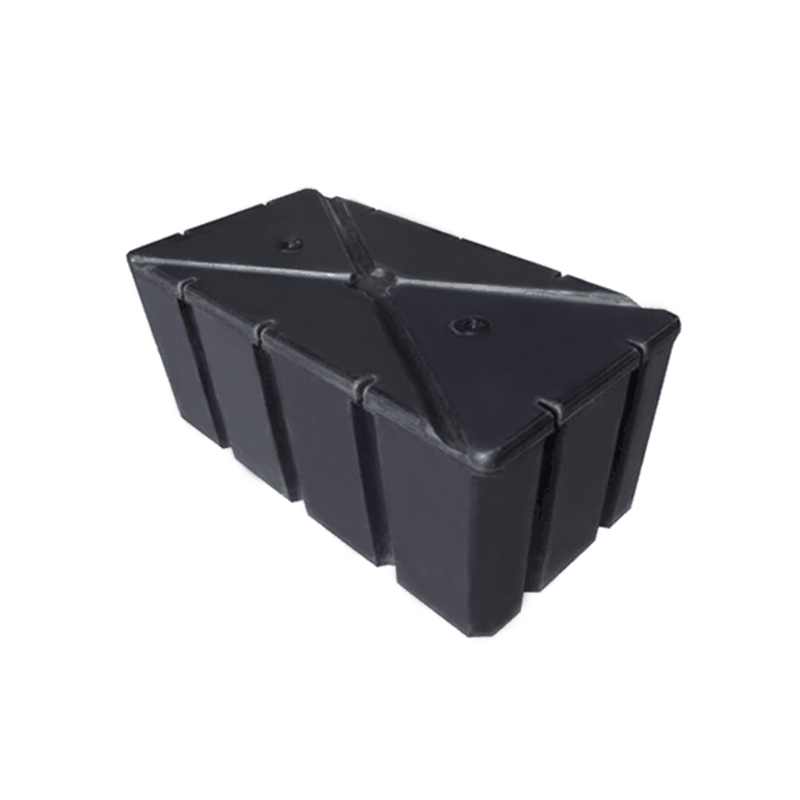
For a concrete example: a standard dock float with external dimensions of 600 mm × 600 mm × 300 mm has a gross displacement volume of 108 liters (108 kg of water displaced). At a designed wall thickness of 6 mm, the LLDPE shell weighs approximately 8.2 kg, giving a net buoyancy of 99.8 kg. If average wall thickness increases to 8 mm due to poor thickness distribution — with the same total powder charge but concentrated at the bottom — the shell weight increases to approximately 10.9 kg and net buoyancy drops to 97.1 kg. This 2.7 kg reduction in net buoyancy per float becomes critical when floats are rated and sold against specific load capacity specifications, and when multiple floats are assembled into a floating dock system where cumulative buoyancy errors determine whether the platform sinks under rated load.
More critically, wall thickness variation — not just average thickness — creates buoyancy distribution problems. A float that is thick at the bottom and thin at the top will sit lower in the water on the thick side regardless of whether the total displacement volume is correct, because the center of gravity is shifted toward the thick, heavy section. This produces a float that lists rather than sitting level, which is unacceptable for dock platform applications where level surface is a fundamental performance requirement.
Eliminating thickness variation requires identifying which of the five root causes is producing the defect in a specific production situation. Each cause produces a characteristic pattern of thickness variation that can be identified by destructive sectioning of test parts.
Rotational molding machines rotate the mold simultaneously around two perpendicular axes. The ratio of major axis speed to minor axis speed determines how the powder distributes across the mold interior during the heating phase. For most float geometries, a major-to-minor axis rotation ratio of 4:1 to 8:1 is the starting point, but the optimal ratio is geometry-specific. An incorrect ratio causes the powder pool to consistently lag behind the rotation, concentrating material at corners or one face of the float.
The diagnostic signature of a rotation ratio problem is systematic thickness variation that repeats consistently across all parts in a production run — thick at the same location and thin at the opposite location on every float. If sectioning shows the bottom of the float is consistently 30–40% thicker than the top, the major axis rotation speed is too slow relative to the minor axis, and the powder is pooling at the bottom before it sinters.
Powder sinters onto the mold surface in proportion to the local surface temperature — hotter areas sinter more powder faster. If the mold has temperature gradients across its surface (common at parting lines, thick mold sections, and areas shielded from direct oven airflow), the plastic builds up faster at hot spots and thinner at cold spots. A 15°C temperature differential across the mold surface can produce wall thickness variations of 25–35% between hot and cold zones in a typical LLDPE float compound.
Under-charging the mold produces a float with globally thin walls — all sections are proportionally thinner than design, but the variation pattern may appear relatively uniform. Over-charging causes pooling of excess material at the last area of the mold to receive powder (typically the parting line area or the bottom of the mold at the end of the heating cycle), creating locally thick sections that throw off both the weight distribution and the buoyancy center.
Powder charge weight must be calculated from the target wall thickness and total mold surface area with a correction for LLDPE bulk density variability. Charge weight tolerance should be held to ±1% of target — for a float requiring a 2.5 kg charge, this means weighing to ±25 g. Volumetric charging (using a fixed volume scoop) is insufficient for quality production; gravimetric charging with a calibrated scale is mandatory.
Float geometries with deep recesses, narrow channels, internal ribs, or sharp internal corners create areas where the rotating powder pool cannot reach effectively. These geometric dead zones consistently produce thin or missing walls. The problem is inherent to the mold design and cannot be fully corrected by process adjustment — it must be addressed at the design stage by adding draft to internal features, opening up channel widths to a minimum of 3× the target wall thickness, and avoiding internal concave corners with radii less than 5 mm.
If the mold begins cooling before all powder has sintered onto the walls — either because oven temperature is too low, heating time is too short, or the mold exits the oven with unsintered powder still in the interior — the remaining powder bridges across the interior rather than depositing uniformly. Bridging creates a characteristic defect where large internal voids alternate with thick polymer deposits, and the float will have unpredictable buoyancy and structural properties. A properly sintered float interior should have no free powder remaining when the mold is opened.
Unlike injection molding where wall thickness tolerance of ±0.1 mm is achievable, rotational molding is inherently a lower-precision process. However, industry practice and float performance requirements establish the following working tolerance guidelines:
| Float Application | Target Wall Thickness | Acceptable Variation | Maximum Allowable Thin Point | Consequence of Exceeding Limit |
|---|---|---|---|---|
| Recreational dock float (light duty) | 5–7 mm | ±20% | 4 mm | Impact cracking, list under load |
| Commercial marina float (medium duty) | 7–10 mm | ±15% | 6 mm | Fatigue failure at thin zones under wave loading |
| Industrial/port float (heavy duty) | 10–15 mm | ±12% | 9 mm | Structural failure under rated point load |
| Aquaculture / fish farm float | 6–9 mm | ±15% | 5 mm | UV degradation accelerated at thin sections |
| Buoy / navigation marker | 5–8 mm | ±10% | 4.5 mm | Buoyancy reserve failure, listing in current |
Wall thickness variation creates stress concentration in a float under load because stress in a shell structure is inversely proportional to wall thickness — a section that is 50% thinner than the surrounding wall carries approximately twice the stress under the same applied load. For floats subjected to cyclic wave loading, point loads from mooring lines, and impact from boats, these thin zones are where fatigue cracks initiate.
LLDPE has good fatigue resistance in bulk, but its fatigue life is strongly dependent on stress amplitude. Under the cyclic bending imposed by wave action on a moored dock float, a section at the nominal design stress level may survive 10 million cycles without failure. The same material at a thin zone experiencing twice the stress may fail in as few as 50,000–200,000 cycles — in a moderate wave environment with 6-second wave periods, this represents only 3–12 months of service life rather than the expected 10–15 years.
The locations most vulnerable to thin-zone fatigue in a typical dock float are:
Effective quality control of wall thickness requires a measurement method that is practical for production use and sensitive enough to detect variations above the acceptable limit. Three methods are used in float production:
Ultrasonic gauges transmit a sound pulse through the float wall and measure the time of flight to calculate thickness. They work through the outer surface without requiring access to the interior, making them the standard production measurement tool. For LLDPE floats, a 5 MHz transducer with appropriate couplant gel provides measurement accuracy of ±0.1 mm on wall sections of 3–20 mm. Measurement should be taken at a minimum of 12 defined points per float — top center, bottom center, each of the four sides at midpoint, and at the four upper and lower corners — to build a complete thickness map.
For production quality control, measure one float per 20-float production batch at minimum, or the first and last float of each shift. If any measurement falls outside the acceptable tolerance band, expand measurement to every float in the batch and trace back to identify the process variable that changed.
For process setup, new mold qualification, and investigation of suspected defects, destructive sectioning provides the most complete thickness map. Cut the float along its three principal planes using a bandsaw, and measure section thickness at 50 mm intervals around each cut face with a calibrated digital caliper. This typically requires 60–100 individual measurements per float and provides a complete picture of thickness distribution including internal corners and parting line zones that are difficult to reach with an ultrasonic probe.
Every float produced should be weighed after demolding. Total part weight is directly related to total material deposited, and part weight variation of more than ±3% from target is a reliable indicator that the powder charge or sintering process has deviated from specification — even if the variation is too subtle to detect visually. Weight measurement takes less than 30 seconds per float and should be a mandatory 100% inspection step for commercial float production.
Once the cause of thickness variation is identified, the following parameter adjustments address each root cause:
| Thickness Variation Pattern | Probable Root Cause | Corrective Parameter Adjustment | Expected Improvement |
|---|---|---|---|
| Bottom thick, top thin — consistent across all parts | Major axis rotation too slow | Increase major axis speed by 20–30% | Thickness variation reduces from ±25% to ±12% |
| Parting line thin, face centers thick | Parting line heat loss / last-to-sinter | Add thermal insulation strips to parting line flanges; extend heat cycle by 2–3 min | Parting line thickness increases to within ±15% of face centers |
| Corners thin, flat faces correct | Geometric dead zones / powder bridging | Increase internal corner radii in mold to minimum 5 mm; review rotation ratio | Eliminates zero-thickness corner defects |
| Globally thin walls — all sections below target | Under-charged powder weight | Increase charge weight by calculated shortfall; verify scale calibration | Average thickness returns to target within ±5% |
| One face thick, opposite face thin — varies between parts | Inconsistent oven airflow / hot spots | Reposition mold on arm relative to oven burner; check oven airflow baffles | Part-to-part variation reduces; systematic bias eliminated |
| Thick pooling at base with unsintered powder inside | Insufficient oven temperature or heating time | Increase oven temperature by 10°C or extend heating cycle by 3–5 min; verify OITC measurement | Complete sintering achieved; pooling eliminated |
Cooling rate affects wall thickness distribution in a less obvious way than heating parameters but is equally important to final part quality. During cooling, the LLDPE shell shrinks as it solidifies — if the mold cools non-uniformly, different zones of the float solidify and lock in their dimensions at different times, creating internal residual stress and dimensional warping that changes the effective wall thickness distribution in the finished part.
For float production, the critical cooling parameter is cooling rate uniformity rather than cooling rate speed. Cooling too fast (aggressive water mist or forced air directed at one face) creates a large temperature gradient across the mold, causing the cooled side to solidify and shrink while the opposite side is still molten — this pulls material toward the cooling side, thickening it and thinning the opposite face. A controlled cooling rate of 3°C–5°C per minute during the initial solidification phase (from melt temperature to approximately 100°C) produces the most uniform thickness distribution and lowest residual stress in the finished float.
Continuing to rotate the mold during the early cooling phase — until the LLDPE surface temperature drops below approximately 120°C — also improves thickness uniformity by preventing the still-softened material from sagging under gravity toward the lowest point of the mold before it fully solidifies.
Beyond buoyancy and fatigue considerations, wall thickness determines the float's resistance to impact — from boat hulls, dock hardware, ice formation, and dropped equipment. LLDPE's impact resistance is strongly thickness-dependent: the energy absorbed by the wall in a ductile impact failure scales approximately with the square of wall thickness, meaning a wall that is 30% thinner absorbs approximately 50% less impact energy before fracturing.
Practical minimum wall thickness values for LLDPE float applications based on service environment:

 wuyuqiao village, Henghe Town, Cixi City, Zhejiang Province
 +86-15257871220
 [email protected]
