

 English
 عربى
عربى
News
Home / News / Industry News / HDPE Rotomolding: Key Properties, Benefits, and Industrial Applications
Ask any plant manager why they chose HDPE for a rotomolded tank, and you will likely hear the same answer: stiffness. HDPE rotational molding gives you the rigidity of a high-density polyethylene part without the weld lines or weak points that come with other molding methods. If your application involves chemicals, pressure, or long spans between support points, HDPE should be near the top of your list.
Getting there requires more attention to process control than with LLDPE, but the payoff is a part that holds its shape, resists creep, and stands up to aggressive media. This guide explains how HDPE rotomolding works, how it compares with LLDPE, and what to look for in a manufacturing partner.
HDPE rotomolding is simply the rotational molding process using high-density polyethylene as the resin. The material is ground into a fine powder or extruded into micro-pellets, placed inside a hollow aluminum or steel mold, and the mold is heated while rotating on two perpendicular axes. The polymer melts, coats the inside of the mold, and forms a seamless, stress-free part as the mold cools.
Because the mold rotates in two planes, wall thickness stays uniform even on complex geometries. Corners, ribs, and inserts can be molded in without secondary joining. HDPE specifically contributes a higher crystallinity and density than LDPE or LLDPE, which translates into more rigidity, better heat resistance, and lower permeability to solvents and water vapor.
Molds are usually machined from aluminum or fabricated from steel for high-volume runs. For HDPE, the mold must include venting to let displaced air escape; otherwise, trapped air can cause surface pinholes and incomplete filling.
One of the most common questions in rotomolding is which polyethylene grade to choose. The table below gives a practical comparison between HDPE and LLDPE for rotational molding.
| Property | HDPE | LLDPE |
|---|---|---|
| Density (g/cm³) | 0.941 – 0.965 | 0.915 – 0.925 |
| Flexural modulus (MPa) | 800 – 1,300 | 400 – 800 |
| Tensile strength at yield (MPa) | 20 – 30 | 12 – 20 |
| Impact resistance | Moderate | Excellent |
| Stress crack resistance | Good | Excellent |
| Shrinkage during cooling | Higher | Lower |
| Wall stiffness | High | Moderate |
The short version: choose HDPE when the part must resist bending, indentation, or internal pressure at elevated temperatures. Choose LLDPE when impact toughness and resistance to stress cracking matter more. Many rotomolders stock both materials, and a good contract manufacturer will help you select the right grade for the actual service environment.
One way to think about it is that HDPE behaves more like a structural plastic, while LLDPE behaves more like a tough elastomer. In a tank application, HDPE gives you a firmer feel and better resistance to buckling when the tank is partially full. In a float or road barrier, where impacts are likely, LLDPE's deflection and impact resistance may be more valuable.
Rotomolding HDPE is less forgiving than molding LDPE or LLDPE. Because HDPE has a sharper melting point and higher crystalline content, the oven time, peak temperature, and cooling rate must be tightly controlled. If the powder particles are too coarse, the inner surface will show pinholes; if the oven temperature is too high, the material may degrade; if cooling is uneven, the part can warp.
Typical rotational molding conditions for HDPE involve a mold temperature in the range of 250–350 °C, a peak internal air temperature of 190–220 °C, and a slow, controlled cooling phase. Shrinkage rates also tend to run slightly higher than LLDPE, so mold dimensions and cooling fixtures need to be adjusted accordingly.
Powder quality matters as well. HDPE is more likely to need a tighter particle size distribution than LLDPE because larger particles can create flow lines. Most experienced rotomolders pulverize HDPE to a similar target mesh, but they adjust the grinding conditions to prevent excessive fine dust. Some also use internal pressure sensors to monitor peak air temperature and decide precisely when to drop the mold out of the oven.
HDPE rotomolding appears in industries where structural performance and chemical resistance cannot be compromised. Common examples include bulk chemical storage tanks, mixing tanks, dosing tanks, containment trays, industrial equipment housings, water treatment components, and agricultural sprayer tanks.
For vertical storage tanks, HDPE's stiffness allows taller walls to resist hoop stress without excessive wall thickness. The cone-bottom design of many industrial tanks also benefits from HDPE's dimensional stability, especially when the tank is filled with dense liquids. A typical example is the CPT5000L cone-bottom PE storage tank, which rotomolders produce with a seamless wall and integrally molded fittings. Molders also design for the mechanical loads that tanks see in transit, a topic covered in a closer look at clean water tank stability on uneven roads.
 CPT-5000L Cone Bottom PE Storage Tank for Industrial UseA rotomolded HDPE storage tank with a cone bottom and seamless wall, suited for dense liquids and demanding industrial environments where dimensional stability and corrosion resistance matter.View Product →
Mixing tanks and dosing barrels are another natural fit. These parts often see agitator loads, nozzle torque, and repeated exposure to acids or alkalis. The higher stiffness of HDPE reduces flexing at mounting bosses and keeps dimensional tolerances around threaded inserts. For larger volumes, a 10-ton PE mixing barrel gives process engineers a seamless, corrosion-proof vessel.
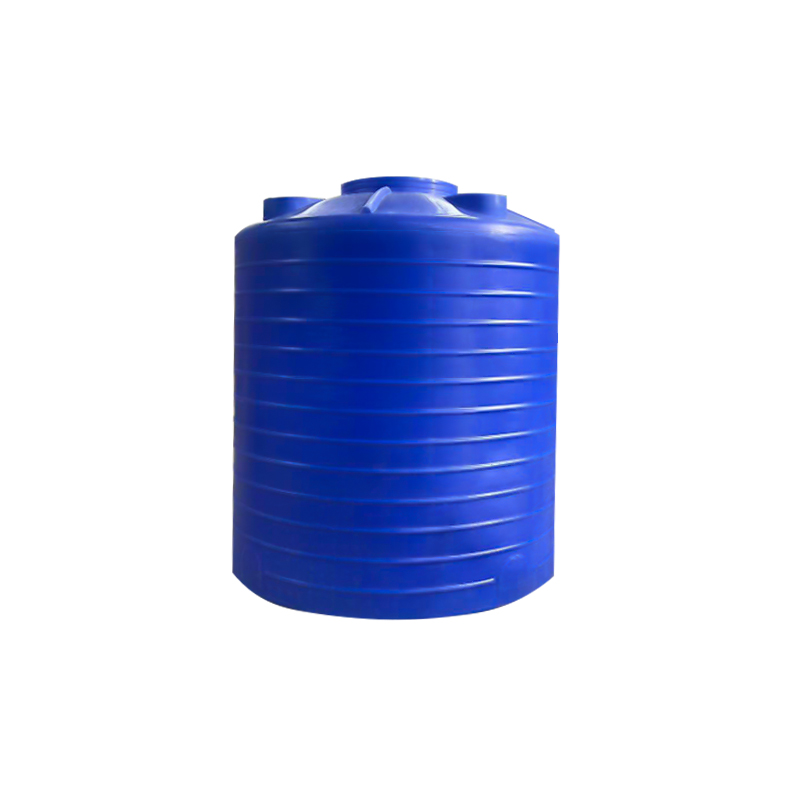 10-Ton PE Mixing Barrel for Chemical ProcessingA large-capacity rotomolded barrel designed for mixing and dosing applications, offering stiffness and corrosion resistance to withstand agitator loads and repeated chemical exposure.View Product →
In chemical storage areas, leakproof trays are now a standard safety requirement. A rotomolded tray made from HDPE provides the same chemical compatibility as the tank itself, with a smooth interior that is easy to inspect and clean. The ability to mold handles and drain basins directly into the tray eliminates assembly steps.
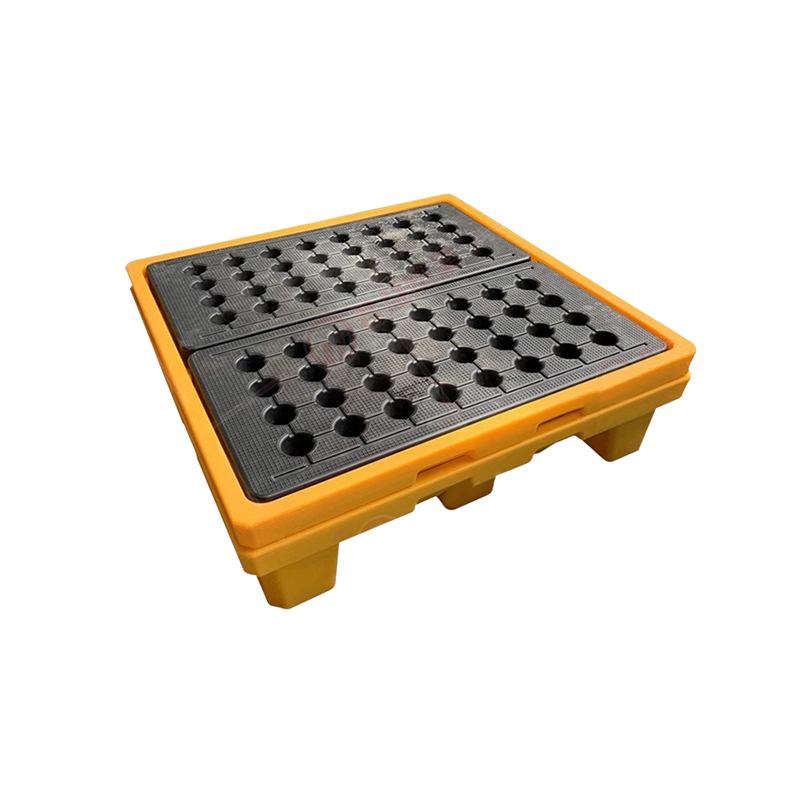 Rotomolded Leak-Proof Bucket Tray for Chemical StorageAn HDPE tray with molded handles and drain basins, providing a smooth, easy-to-clean containment solution that is chemically compatible with stored liquids.View Product →
Beyond tanks and trays, HDPE rotomolding is used for:
Not every rotomolder has the experience to run HDPE profitably. Before placing an order, ask about their powder handling, mold temperature control, and cooling procedures. Confirm that they have done HDPE projects before, because the learning curve is real.
Also consider the full product chain. A partner that designs and machines its own molds, like Cixi Junyi Plastic Industry, can iterate faster on shrinkage compensation and gate placement. The company is located in the rotomolding hub of Cixi, near major logistics routes, and offers both standardized products and custom OEM development. If you need support on part design, material selection, or mold tooling, an experienced manufacturer can make the difference between a prototype that works and a production run that fails.
Inspect their quality system and ask for material certifications. A reliable partner should be able to document the resin grade, lot traceability, and wall-thickness checks. They should also help you understand lead times, especially for HDPE because longer cooling phases may extend cycle times compared with LLDPE.
Do not overlook cost engineering. HDPE resin is sometimes more expensive per kilogram than LLDPE, but its higher stiffness may allow a slightly thinner wall in certain designs. The net cost depends on geometry, volume, and the secondary operations required. A good partner will discuss these trade-offs openly before you commit to tooling.
HDPE rotomolding is not the easiest material to run, but the results speak for themselves. When you specify the right grade, invest in proper tooling, and work with a molder that understands the process limits, you get parts that are strong, lightweight, corrosion-resistant, and surprisingly affordable for low-to-medium volumes. Start with your service requirements, not just the material datasheet, and let an experienced partner help you from mold design to final part.

 wuyuqiao village, Henghe Town, Cixi City, Zhejiang Province
 +86-15257871220
 [email protected]
